
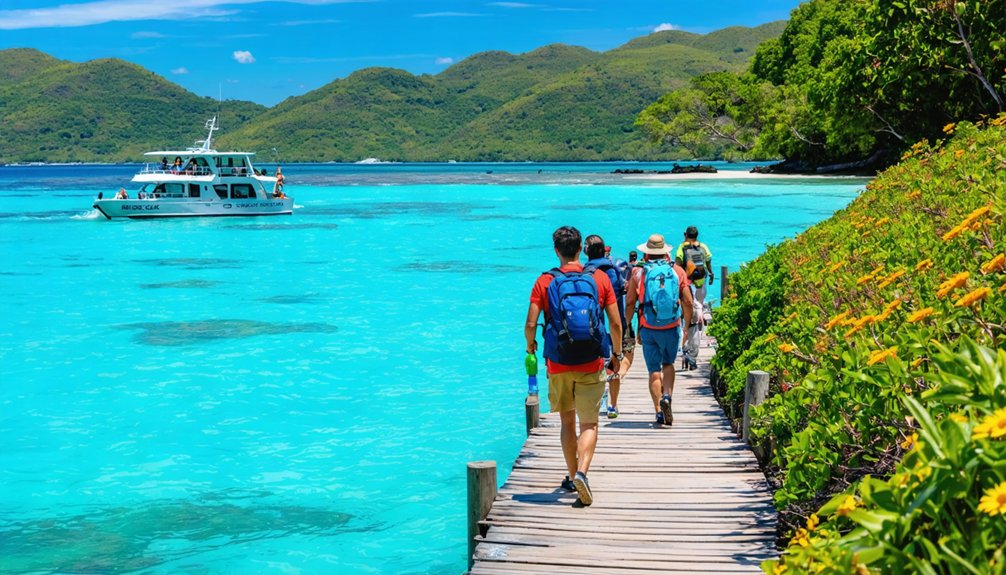

Sustainable tourism is expanding because consumer demand for low‑carbon travel now exceeds 75 % of global bookings, especially among Millennials and Gen Z. Eco‑certified accommodations capture 41.8 % of the market, while online platforms handle 62.4 % of transactions, enabling rapid scaling. Regional policies in the US, Europe, and India boost growth, and technology—AI‑driven carbon accounting, blockchain verification, and smart‑destination analytics—provides transparent, personalized experiences. Continued exploration reveals deeper insights into segment dynamics and emerging opportunities.
Highlights
- Travelers increasingly prioritize sustainability, with 75‑80 % rating it a booking factor and millennials/Gen Z driving carbon‑offset purchases.
- Independent travelers (48.6 % of bookings) favor off‑the‑beaten‑path, low‑impact itineraries, boosting demand for eco‑certified lodging and regenerative experiences.
- Coastal and island tourism dominate growth, accounting for 45 % of the sustainable market and expanding at 15.1 % CAGR due to marine and regenerative tourism.
- AI‑driven personalization, carbon accounting, and blockchain verification enhance transparency and trust, aligning with EU CSRD, OECD, and UNWTO standards.
- Renewable‑energy infrastructure and community‑owned regeneration projects create carbon‑negative destinations, delivering measurable biodiversity and emissions benefits.
How Sustainable Tourism Is Redefining Global Travel Trends
Why are travelers abandoning crowded hubs for quieter, more meaningful experiences? A shift from volume‑driven tourism to value‑centric journeys is measurable: searches for secondary Asian destinations rise 15 % faster than traditional hubs, and 75‑80 % of global travelers now rate sustainability as a booking priority.
Green certifications increasingly influence choice, as platforms display verified eco‑labels and sustainability dashboards.
Community co‑ownership models redistribute revenue, ensuring local stakeholders shape itineraries and benefit from visitor spend.
Data show that low‑impact transport and off‑season travel reduce pressure on popular sites while cutting costs.
The trend aligns with heightened climate awareness, a digital‑detox mindset, and a demand for authentic, nature‑rich immersion that nurtures belonging within resilient, regenerative communities. Travelers are also seeking cultural immersion experiences that support Indigenous‑owned businesses and preserve local heritage. Regenerative tourism is now a key driver of destination strategy. Contactless payment systems across attractions streamline visitor flow and reduce physical touchpoints.
What Market Data Shows About the Explosive Growth of Eco‑Travel?
Because the sustainable‑tourism sector is expanding at a pace that outstrips traditional travel markets, analysts cite a valuation of USD 2.3 trillion in 2026 projected to surge to USD 17.8 trillion by 2036—a 22.6 % CAGR according to Future Market Insights. Data reveal Eco/Green Tourism now commands 41.8 % of market share, with online booking accounting for 62.4 % of transactions. Independent travelers, representing 48.6 % of bookings, drive demand for carbon‑offset incentives, reinforcing traveler loyalty through measurable environmental impact. Regional analysis shows the United States leading in value, while India and China post the fastest growth rates. The domestic segment, valued at USD 2.2095 trillion in 2024, highlights the sector’s broad, inclusive appeal. Emerging markets are contributing significantly to overall market acceleration. Europe accounts for 38.9 % of growth during the forecast period. North America remains the largest region, reflecting strong consumer demand for sustainable travel options.
Which Traveler Preferences Are Driving the Shift Toward Green Experiences?
What drives travelers toward green experiences is a convergence of measurable preferences that prioritize depth over volume, nature reconnection, cultural immersion, generational sustainability priorities, and wellness‑focused regeneration.
Data show a 38 % shift among millennials and 42 % among Gen Z toward carbon‑offset purchases and certified lodging, double the boomers’ rate.
Mind‑tourism manifests in off‑the‑beaten‑path itineraries—Scotland’s Highlands in winter, secondary Thai cities—where longer stays reduce crowding and cost.
Nature reconnection fuels demand for protected parks, rewilding projects such as Skyline Hawai‘i, and low‑impact transport.
Cultural immersion is driven by over half of travelers seeking authentic local narratives and community‑led programming.
Regenerative travel expectations now emphasize measurable biodiversity, and emissions mitigation, aligning wellness with systemic, transparent impact. Hotel hopping offers travelers the chance to experience multiple neighborhoods within a single destination, enhancing both cultural immersion and sustainable mobility. Aviation contributes a significant share of tourism emissions.
How Regional Dynamics Shape Sustainable Tourism Opportunities
Regional dynamics dictate the distribution of sustainable tourism opportunities, as spatial disparities, policy structures, and infrastructure investments intersect to shape where and how green travel can flourish.
In Europe, uneven tourism density and COVID‑19‑induced regional policy divergence have prompted place‑based strategies that mitigate habitat fragmentation impacts while channeling funds into eco‑transport and digital connectivity. Tourism’s economic significance drives investment in resilient infrastructure to support long‑term growth. High‑growth markets like the Maldives and Seychelles exemplify premium willingness to pay for luxury eco‑resorts powered by renewable energy.
North America’s 35 % market share reflects coordinated regional incentives that prioritize Indigenous cultural preservation and low‑carbon lodging, reinforcing community belonging through certified green standards.
India’s rapid 27.1 % growth stems from state‑level promotions that integrate heritage and community‑based eco‑tourism into mainstream circuits, reducing habitat fragmentation impacts via localized waste‑reduction loops.
Coastal, mountain, and island zones utilize regenerative models, expanding circular economies and hyper‑local experiences that align visitor identity with regional sustainability goals. CAGR 15.2 %
What Key Segments Lead the Market and Why They Matter?
Regional dynamic have set the stage for identifying the market‑leading segments, and the data reveal that coastal tourism accounts for 45 % of the sustainable tourism market, contributing nearly 70 % of overall share across all types.
Market segmentation shows coastal ecotourism, marine tourism, and responsible water sports as the primary growth drivers, leveraging high‑visibility ecosystems and strong community partnerships.
Mountain tourism, while smaller, fuels high‑value, low‑volume experiences and supports biodiversity, positioning it as a strategic niche.
Island tourism expands at 15.1 % CAGR, driven by regenerative practices and equitable economic benefits.
Eco‑green tourism holds 41.8 % of demand, integrating certified lodging and conservation criteria that shape consumer expectations.
Community tourism enhances guest satisfaction by 12 % through authentic, culturally rooted experiences, reinforcing the sector’s inclusive appeal.
The sustainable tourism market reached $3,748.09 bn in 2025, underscoring its rapid growth.
The United States holds the largest share by value, with a steady expansion rate of 8.0 % CAGR.
North America leads the global market, accounting for approximately 38 % of total sustainable tourism revenue.
Which Technological Innovations Are Accelerating Sustainable Travel?
Accelerating sustainable travel hinges on the convergence of AI‑driven personalization, carbon‑tracking applications, renewable‑energy platforms, smart‑destination structures, and regenerative travel tools.
AI-driven carbon accounting integrates real‑time footprint data into booking engines, allowing travelers to select low‑emission itineraries and green accommodations.
Blockchain provenance verification secures supply‑chain transparency for eco‑certified services, reinforcing consumer trust.
Smart‑destination frameworks, highlighted at ITB Berlin 2026, employ predictive analytics to balance visitor flow with cultural preservation, while renewable‑energy platforms showcase carbon‑negative locales such as Bhutan and Norway.
Regenerative travel tools further small‑group experiences and local guide networks, converting expenditures into measurable ecosystem benefits.
Collectively, these innovations convert data into actionable sustainability, cultivating a sense of community among eco‑conscious travelers. European Tourism Day livestream will showcase these advancements to a global audience.
What Challenges Remain and How the Industry Is Overcoming Them?
Balancing visitor growth with environmental stewardship remains a core challenge, as overtourism metrics have risen 14 points year‑over‑year while concerns over insufficient amenities climbed 12 points, prompting destinations to adopt flexible pricing and promote off‑the‑beaten‑path alternatives.
Industry reports show that supply financing is increasingly channeled through green financing mechanisms that prioritize circular procurement and carbon accounting, enabling policy alignment across EU CSRD, OECD, and UNWTO mandates.
Data harmonization initiatives reduce jurisdictional friction, allowing stakeholder collaboration to embed climate resilience and biodiversity protection into operational plans.
Community empowerment programs, backed by targeted financing, encourage local ownership of sustainability targets, while integrated carbon‑tracking tools support transparent Scope 3 disclosures.
Together, these measures create a cohesive structure that mitigates environmental risk and sustains growth.
References
- https://www.openpr.com/news/4402343/sustainable-tourism-market-outlook-2026-2036-industry
- https://www.marketresearch.com/Infiniti-Research-Limited-v2680/Global-Sustainable-Tourism-44153577/
- https://www.businessresearchinsights.com/market-reports/sustainable-tourism-market-117815
- https://cascadestrategies.com/brandview-world/the-travel-and-tourism-industry-takes-flight-in-2026/
- https://www.oxfordeconomics.com/resource/key-global-trends-defining-tourism-in-2026/
- https://initiatives.weforum.org/experience-economy/travel-and-tourism
- https://www.tourismcares.org/tourism-cares-blog/2026-travel-trends-reframing-sustainability-for-the-future-of-travel
- https://www.thetourismspace.com/blog/trends-shaping-sustainable-tourism-in-2026
- https://transition-pathways.europa.eu/tourism/knowledge-documents/7-megatrends-shaping-tourism-2026-future-travel-patterns
- https://www.bandwango.com/resources/7-tourism-trends-for-2026-beyond-what-destinations-must-watch