
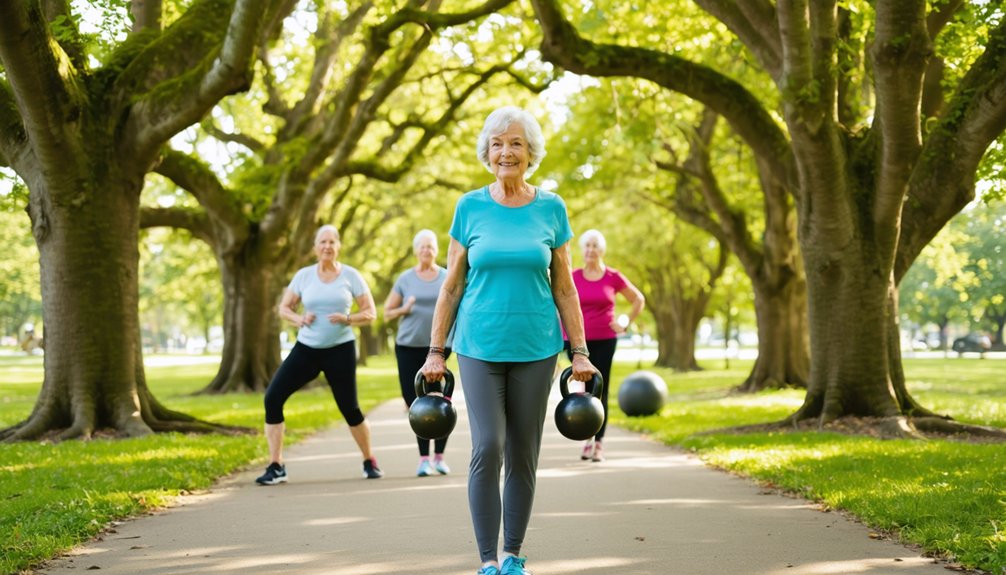

Strength training cuts all‑cause mortality by roughly 15 % and lowers heart‑disease and cancer death risks through muscle‑mass preservation, enhanced insulin sensitivity, and bone‑density maintenance. It slows biological aging, extending leukocyte telomere length by 6–7 base pairs per ten minutes of weekly work and reducing oxidative stress. Regular resistance exercise prevents sarcopenia, improves balance, and diminishes fall‑related fractures. It also eases diabetes, osteoarthritis, and chronic back pain. Continuing will reveal detailed protocols for achieving these longevity benefits.
Highlights
- Strength training reduces all‑cause mortality by up to 15 % and cardiovascular death by 10‑17 % through improved heart health and metabolic function.
- Regular resistance work preserves telomere length, slowing biological aging by roughly four years at 90 min/week.
- It combats sarcopenia, increasing muscle mass, strength, and gait speed, which lowers fall risk and maintains functional independence.
- Resistance exercise boosts bone mineral density and slows age‑related bone loss, decreasing fracture risk.
- Enhanced insulin sensitivity and glucose uptake from strength training improve glycemic control, reducing diabetes complications and associated mortality.
How Strength Training Cuts All‑Cause Mortality
When examined across thousands of studies, resistance training consistently lowers the risk of death from any cause.
Meta‑analysis of non‑clinical adults shows a 15 % all‑cause mortality reduction (RR = 0.85) for any strength work, with a nonlinear dose‑response peaking at 60 min/week for a 27 % drop (RR = 0.74).
Women derive disproportionate benefit: three weekly sessions cut mortality by ~28 % versus 14 % in men, and a single session in women matches men’s three‑session effect.
Cohort data on older adults confirm a 6 % lower risk (HR = 0.94) for any weight training, amplified when combined with aerobic activity.
The underlying mechanism centers on nuclear muscle preservation, which sustains functional capacity and drives mortality reduction across diverse populations.
Non‑clinical adult studies provide the evidence base for these conclusions.
The study’s J‑shaped curve indicates that optimal dose of strength training is around 146 min/week, with higher mortality risk below this threshold.
Gender‑specific response shows that women achieve maximal benefit at a lower weekly volume than men.
How It Lowers Heart‑Disease and Cancer Death Risks
While strength training is often highlighted for preserving muscle mass, data show it also markedly reduces mortality from heart disease and cancer.
Epidemiological analyses reveal that 30‑60 minutes of weekly resistance work cut early heart‑disease death by 10‑17 % and lower overall cardiovascular risk by 17 % compared with inactivity.
Blood‑pressure, lipid, and arterial‑stiffness improvements underpin this cardiovascular resilience, while combined aerobic‑strength programs amplify mortality reductions to 40‑46 %.
Cancer findings indicate a 10‑15 % lower death risk among regular weight‑trainers, with women experiencing the greatest benefit; synergistic effects emerge when strength training pairs with aerobic exercise.
Mechanistically, resistance bouts promote immune modulation, enhancing surveillance and reducing tumor progression.
These data‑driven outcomes affirm strength training as a cornerstone of collective health longevity. Regular strength training also lowers metabolic‑syndrome risk by 29 %, further supporting its role in disease prevention. The study showed that combined training improves both VO₂max and muscular strength without extra time burden. The trial also demonstrated that cardio alone significantly improves the CVD risk profile, highlighting the importance of aerobic exercise alongside resistance training.
How Resistance Exercise Slows Biological Aging (Telomeres & Metabolism)
Ten minutes of weekly resistance training is associated with an additional 6.7 base pairs of leukocyte telomere length, translating to roughly four years of reduced biological aging at a 90‑minute weekly dose.
Empirical data show that adults who engage in ≥1 hour of strength training per week possess considerably longer telomeres than non‑trainers (F = 6.9, p = 0.013), and each extra 10 minutes adds 6.7 base pairs after covariate adjustment.
This telomere preservation parallels reductions in oxidative stress and systemic inflammation, promoting metabolic regulation.
While resistance exercise does not raise telomerase activity like aerobic modalities, it promotes type II fiber hyperplasia and mitigates metabolic decline.
The linear dose‑response relationship persists across diverse cohorts, underscoring resistance training as a pragmatic, community‑building strategy to decelerate biological aging.
Moderate exercise also shows a positive association with longer telomeres, supporting the broader benefit of physical activity.
How It Preserves Muscle Mass and Prevents Sarcopenia
Utilizing progressive resistance exercise preserves skeletal muscle mass and counters sarcopenia by stimulating protein synthesis, hypertrophy, and neuromuscular adaptation. Evidence shows that 8‑week high‑intensity programs raise nonagenarian muscle strength by 174 % and mid‑thigh area by 9 %, while gait speed improves 48 %. Meta‑analyses of 12 RCTs (518 women) confirm significant gains in handgrip, knee extension, and chair‑rise performance after 2–3 weekly 30‑minute sessions. The physiological basis lies in enhanced muscle metabolism and favorable hormonal regulation, which together amplify protein synthesis and attenuate catabolic signaling. Low‑load blood‑flow restriction and elastic‑band protocols achieve comparable hypertrophy with minimal risk, reinforcing progressive resistance training as the first‑line, community‑building strategy against sarcopenia. Cluster‑set training further maximizes volume while minimizing fatigue, offering an efficient approach for older adults. Incorporating regular resistance bands can improve joint stability and reduce fall risk.
How Stronger Bones and Better Balance Reduce Falls and Fractures
Why do stronger bones and improved balance matter for aging adults? Evidence shows resistance training raises bone density by stimulating osteoblasts, yielding up to 3.8 % BMD gains in spine, hip and upper limbs.
Meta‑analyses confirm a 1 % annual slowdown in age‑related loss after age 40, especially with moderate‑intensity, three‑day‑per‑week protocols.
Enhanced bone density directly lowers fragility, while multi‑joint exercises such as squats and deadlifts improve skeletal resilience.
Concurrently, strength work sharpens proprioception and postural control, key components of Fall prevention.
The combined effect reduces the incidence of minor falls and the likelihood of fractures from everyday movements, nurturing a sense of security and belonging within active older‑adult communities.
Weight‑bearing activities such as walking and stair climbing further stimulate bone remodeling, increasing bone strength in the hips and spine. Regular strength training also improves balance to reduce fall risk. Moderate‑intensity training has been shown to produce the greatest BMD improvements in postmenopausal women.
How Strength Work Improves Chronic Conditions Like Diabetes, Osteoarthritis, and Back Pain
Stronger bones and better balance set the stage for broader health gains, as resistance training also targets metabolic and musculoskeletal disorders.
In diabetes, systematic reviews show that regular strength work lowers HbA1c by roughly 0.44 % in normal‑weight patients, outperforming aerobic protocols, and that each kilogram of added appendicular lean mass predicts further reduction.
Muscle glucose uptake improves for up to 48 hours post‑session, extending glycemic control beyond the workout window.
For osteoarthritis, enhanced joint stability derives from stronger peri‑articular muscles, reducing load on cartilage and mitigating pain without pharmacologic intervention.
Likewise, back‑pain sufferers benefit from reinforced core and spinal support muscles, which promote proper posture and diminish mechanical strain.
Collectively, these adaptations nurture a sense of collective resilience, encouraging continued participation in community‑based strength programs. Resistance training also improves insulin sensitivity, reducing the body’s need for insulin and aiding long‑term glucose management. Regular progressive overload ensures continued muscle adaptation and metabolic benefit.
How to Meet the 2‑Day‑Per‑Week Guideline for Maximum Longevity Benefits
How can individuals translate guideline recommendations into a practical routine that yields the full longevity advantage of twice‑weekly resistance training?
A concise schedule of two 30‑ to 60‑minute sessions, each covering all major muscle groups with one set to fatigue, meets the Department of Health and Human Services and ACSM standards while staying within the mortality‑reducing 2‑day window.
Emphasizing progressive overload—starting with bodyweight squats, lunges, and push‑ups before adding free weights or machines—ensures continual adaptation.
Pairing these workouts with a balanced dieting plan supports muscle synthesis and metabolic health.
Mind‑focused breathing during sets enhances neural recruitment, and Social‑support loops, such as group classes or partner accountability, reinforce adherence, creating a community‑driven habit that maximizes longevity benefits.
References
- https://www.psu.edu/news/research/story/strength-training-helps-older-adults-live-longer
- https://www.womenshealthmag.com/fitness/a69683218/strength-training-8-years-younger-study/
- https://www.hebrewseniorlife.org/blog/aging-strong-why-strength-training-essential-older-adults
- https://www.rwjbh.org/blog/2025/january/the-importance-of-strength-training-as-we-age/
- https://pmc.ncbi.nlm.nih.gov/articles/PMC12205185/
- https://www.health.harvard.edu/healthy-aging-and-longevity/want-to-live-longer-and-better-do-strength-training
- https://pmc.ncbi.nlm.nih.gov/articles/PMC10199130/
- https://pubmed.ncbi.nlm.nih.gov/35599175/
- https://www.ahajournals.org/doi/10.1161/jaha.117.007677
- https://www.aafp.org/pubs/afp/afp-community-blog/entry/strength-training-associated-with-reduced-mortality-in-women.html