
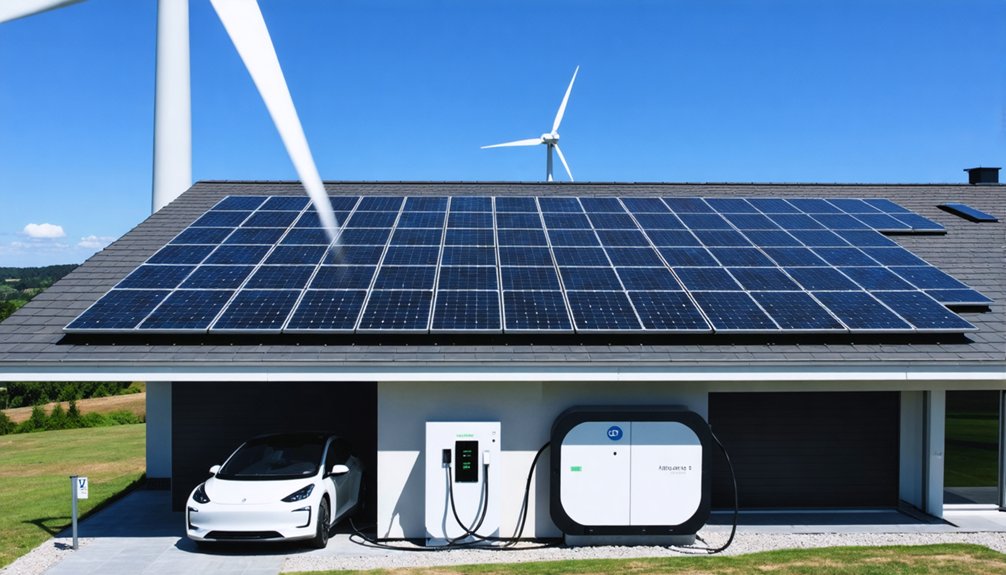

Green technology cuts energy use by installing high‑efficiency insulation, LEED‑certified envelopes, and AI‑driven building‑management systems that lower heating, cooling, and lighting loads by up to 25 %. Energy‑Star appliances and heat‑pump retrofits reduce household bills by $100–$3,100 annually, while demand‑response optimization trims HVAC costs up to 25 %. Circular‑economy practices divert waste, cutting transport energy by 30 % and saving billions of tons of CO₂. Renewable solar, wind, and battery storage replace fossil generation, providing 24/7 clean power and slashing long‑term costs. Continued exploration reveals deeper understanding into sector‑specific impacts and emerging innovations.
Highlights
- Smart building certifications and insulation upgrades cut energy‑intensity by up to 25 % per square foot, delivering rapid ROI.
- Energy‑Star appliances, heat‑pump retrofits, and AI‑driven demand‑response reduce household and commercial electricity use by 15‑30 %.
- Circular‑economy practices—reusing waste, tire bales, and low‑carbon materials—lower transport and processing energy, saving billions of tons of CO₂ annually.
- Renewable generation paired with battery storage supplies 24/7 clean power, decreasing reliance on fossil‑fuel grid electricity and cutting operational costs.
- AI‑balanced smart grids and IoT‑enabled capture systems optimize load and capture emissions, driving further reductions in overall energy consumption.
How Green Technology Cuts Energy Use in Buildings
How does green technology translate into measurable energy savings in buildings? Data show that smart certification correlates with a 25 % reduction in energy use intensity (EUI) per square foot, after controlling for size, climate, and occupancy.
LEED‑certified structures average 68.4 kBtu/ft² versus 91.5 kBtu/ft² for non‑certified peers, a 23.1 kBtu/ft² gap confirmed by paired t‑tests and nonparametric regression.
Insulation upgrades—rigid foam, cellulose, spray foam—raise R‑values and curb air infiltration, producing $0.13/ft² annual savings. Although installation costs $6.90/ft², a five‑year ROI of $6.30/ft² is typical, reflecting lower heating and cooling loads.
Together, certification and envelope improvements drive the market’s 11 % CAGR, reinforcing a community of owners committed to verified, low‑energy performance. The Asia‑Pacific region is projected to achieve the fastest CAGR of 12.3 % from 2024‑2030.
Buildings account for 40 % of total U.S. energy use. Residential sector contributes a modest share of overall emissions.
Why Energy‑Efficient Practices Slash Operating Costs
Building‑level certifications and envelope upgrades demonstrate that measurable energy reductions translate directly into lower operating expenses. Data show that Energy Star appliances cut household bills by $100–$265 annually, while efficient heat pumps and LED retrofits save $600–$3,100 per residence.
Business sectors achieve 31 % energy cuts without output loss, equating to $2 trillion in yearly savings; HVAC and lighting upgrades alone reduce intensity by 22 %.
Behaviorive financing mechanisms accelerate adoption, bundling rebates with low‑interest loans to lower upfront barriers. Demand‑response optimization, powered by AI‑driven building management systems, trims HVAC costs up to 25 % and aligns load with grid incentives.
Collectively, these practices embed cost‑saving habits into daily operations, nurturing a community of financially resilient, environmentally conscious stakeholders. Energy productivity has increased 170 % since 1970. Over 250,000 families claimed electric or natural‑gas heat‑pump installations. The EPA’s Energy Star program has reduced CO₂ by 4 billion metric tons and saved $500 billion on bills.
How Waste‑Reduction Strategies Amplify Energy Savings
Why does trimming waste translate into measurable energy savings? Data show that diverting 2.02 billion tonnes of municipal waste from landfill reduces transport and treatment energy by up to 30 %, directly cutting utility demand.
Circular looping and material reuse raise recyclate volumes, shifting the waste sector from a net emitter to a net saver of 0.8–1.1 billion tonnes CO₂ annually.
Compacting technologies such as the MKII Tyre Baler lower collection frequency, saving fuel and labor costs; Intelli‑Fill optimizes haul schedules, eliminating half‑empty dumpster runs and providing $10,000 in annual savings for a typical office building.
These efficiencies align with the 43 % of U.S. energy classified as avoidable waste, reinforcing community goals of shared stewardship and lower bills. Potential carbon savings of 2.1–2.8 billion tonnes CO₂ per year by 2030 underscore the climate impact of waste‑reduction strategies. high‑calorific‑value tire bales can be sold to cement kilns, creating additional revenue streams while displacing fossil fuels. Lower conversion efficiency further amplifies overall energy reduction.
The Role of Renewable Energy Adoption in Lowering Consumption
The past year saw utility‑scale solar capacity rise by 27,738 MW, pushing global renewable additions toward 80 % of all new capacity by 2030, while wind contributed an additional 6,174 MW and battery storage expanded 58 % to 15,775 MW.
Rapid adoption of renewable generation has reshaped grid integration, allowing higher penetrations without compromising reliability. Policy incentives—tax credits, renewable portfolio standards, and accelerated permitting—have lowered entry barriers, spurring utility‑scale and distributed installations alike.
Combined with 58 % growth in battery storage, these measures enable real‑time balancing, reducing reliance on fossil peakers and flattening demand peaks. The resulting efficiency gains translate into measurable consumption reductions, reinforcing a collective commitment to a low‑carbon energy future. The 2025 renewable share of U.S. electricity reached about 9 %.
Offshore wind is expected to add ~140 GW by 2030, further diversifying the renewable mix.
The market’s CAGR 9.1 % underscores accelerating investment and cost declines across solar and wind technologies.
Financial Benefits: Tax Credits, Solar PV Savings, and Storage Solutions
How do tax incentives translate into measurable financial gains for renewable projects? Federal tax incentives spurred a 3.7 % rise in U.S. EV sales and underpinned 93 % of capacity additions through September 2025, providing predictable cash‑flow improvements for developers. Solar PV accounted for 80 % of new renewable installations, with distributed rooftop systems contributing 42 % of household capacity, reducing utility bills and enhancing net‑metering returns. Utility‑scale storage grew 35 % YoY, adding 15 GW in 2025 and reaching 37.4 GW operational, providing a clear storage ROI for data centers and commercial users. Combined solar‑storage projects comprised 83 % of renewable growth, providing 24/7 clean power and lowering long‑term energy expenditures. Tax incentives and quantifiable storage ROI together create a financially cohesive ecosystem that encourages broader adoption and community confidence. Asia‑Pacific holds 46 % of total renewable capacity. The global green technology market is projected to reach $74.64 bn by 2030, reflecting a 21.9 % CAGR that underscores the expanding financial incentives for clean energy investments. The record 54 GW of new power‑generating capacity in 2025 underscores the rapid scaling of renewables.
Sector‑Specific Impacts: From Low‑Carbon Construction to Carbon Capture
Over 80 % of new renewable installations now incorporate low‑carbon construction elements, as solar‑glass façades, building‑integrated photovoltaics, and AI‑balanced smart microgrids collectively cut operational energy use by 20–40 % and reduce embodied carbon through optimized material use.
Sector‑specific data show solar‑glass windows replace fossil electricity in 42 % of rooftop projects, while low‑carbon materials trim construction‑phase emissions by up to 30 %.
AI‑balanced smart grids on sites lower grid draw, and IoT‑enabled capture units cut industrial carbon footprints by 15 % annually.
Direct‑air‑capture systems, enhanced by AI, now pair with emerging carbon‑negative fuels, achieving net‑negative emissions in pilot plants.
The integrated approach yields measurable cost savings, reinforces community goals of sustainability, and positions each sector within a shared low‑carbon future.
Future Innovations Driving Even Greater Energy Reductions
Three key innovations—AI‑driven grid optimization, ultra‑low‑cost battery storage, and next‑generation green hydrogen—are set to cut global energy consumption by double‑digit percentages within the next decade.
AI‑grid systems now balance solar, wind, and battery inputs in real‑time, narrowing intermittent gaps identified by Deloitte’s 2026 Outlook as the fastest solution for 24/7 demand.
Battery costs have fallen to less than one‑third of 2023 levels, making storage cheaper than fossil alternatives for over 90 % of new projects.
Simultaneously, hydrogen‑fuel production via renewable‑powered electrolysis achieves higher efficiency, with Bloom Energy’s solid‑oxide cells reaching 60 % electrical conversion and Plug Power deploying 60 000 units to replace combustion.
Together, these data‑driven advances promise double‑digit energy reductions, reinforcing a shared commitment to a low‑carbon future.
References
- https://pmc.ncbi.nlm.nih.gov/articles/PMC10709062/
- https://www.thegreenshot.io/uncategorized/future-of-green-technology/
- https://www.bls.gov/opub/btn/volume-2/pdf/reduce-reuse-recycle-green-technologies-and-practices-at-work.pdf
- https://www.energyinst.org/statistical-review/energy-transition-tracker
- https://greenly.earth/en-us/blog/industries/everything-you-need-to-know-about-green-technology-in-2022
- https://data.worldbank.org/indicator/EG.FEC.RNEW.ZS
- https://onlinelibrary.wiley.com/doi/full/10.1111/1477-8947.12577
- https://ourworldindata.org/grapher/investment-in-renewable-energy-by-technology
- https://www.eia.gov/consumption/commercial/data/2012/pdf/green_buildings_cbecs.pdf
- https://www.huduser.gov/portal/publications/pdf/ten_tech.pdf