
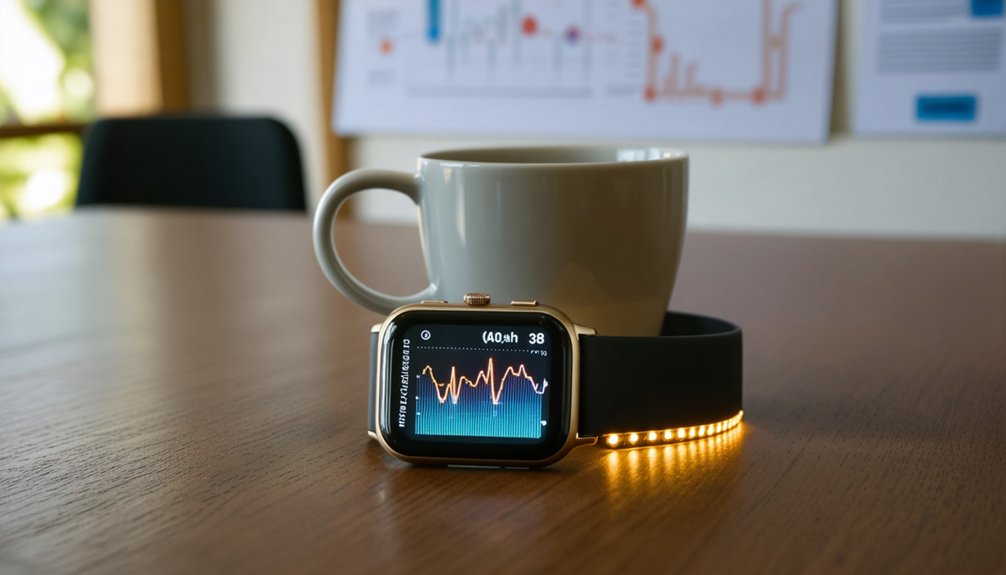

Wearables capture heart rate, activity, sleep, glucose, blood pressure and other signals via Bluetooth or Wi‑Fi, streaming them to cloud servers for real‑time analytics. Minute‑level summaries are aggregated into hourly and daily trends, then processed by AI models such as GFPCA and machine‑learning classifiers that fuse HRV, respiration, skin temperature and GPS environment. These pipelines generate continuous mental‑health scores, predict glucose excursions and flag autonomic stress, enabling proactive health management over months and years. Continued exploration reveals deeper clinical applications and emerging sensor technologies.
Highlights
- Wearables continuously stream sensor data (HR, activity, sleep, glucose, BP) to cloud servers for real‑time aggregation into minute‑hour‑day summaries.
- AI‑driven fusion algorithms combine HRV, respiration, skin temperature, and other modalities to generate longitudinal mental‑health and stress scores.
- Predictive models detect multi‑day patterns, such as glucose excursions or resting heart‑rate trends, enabling early alerts for metabolic or cardiovascular risk.
- Integrated GPS, calendar, and contextual cues personalize nudges and interventions that reinforce long‑term health behavior change.
- Secure, granular consent and interoperable data pipelines encourage sustained sharing, allowing clinicians to track disease progression over months and years.
How Wearables Turn Daily Data Into Long‑Term Health Insights
How do wearables convert moment‑to‑moment measurements into actionable health trajectories? Sensors capture heart rate, activity, sleep, glucose, and blood pressure, streaming data via Bluetooth or Wi‑Fi to cloud servers that store high‑resolution time series.
Real‑time analytics parse incoming streams, while aggregation yields minute, hourly, and daily summaries.
Firmware updates extend battery longevity, ensuring continuous monitoring without frequent charging interruptions.
Advanced algorithms—GFPCA, machine‑learning classifiers, and AI‑driven trend detectors—process these summaries, extracting patterns across days, weeks, and months.
The resulting long‑term insights feed personalized recommendations and community health dashboards, creating a sense of shared progress and collective well‑being. Wearables enable continuous disease monitoring through ongoing data collection. This secure data upload guarantees that each data point is stored safely for future analysis. FDA‑cleared wearable features support clinical research and disease detection.
Which Metrics Reveal Chronic‑Disease Trends Over Months and Years?
Several key metrics—heart‑rate variability, resting heart‑rate trends, blood‑oxygen saturation, step count, continuous glucose readings, and long‑term sleep‑stress patterns—serve as reliable indicators of chronic‑disease trajectories when tracked over months and years.
Heart rate variability trends pinpoint autonomic stress and early cardiac dysfunction, while sustained elevations in resting heart rate flag progressive cardiovascular risk.
Oxygen saturation trends measured by pulse oximetry reveal respiratory decline in COPD or pulmonary fibrosis, enabling timely intervention.
Step count trajectories quantify deconditioning and correlate with metabolic and obesity outcomes.
Continuous glucose monitoring uncovers long‑term metabolic shifts that precede type‑2 diabetes complications.
Sleep‑stress patterns, including apnea detection and chronic stress markers, further delineate disease progression, offering a cohesive data‑driven overview for patients seeking shared health community.
Wearable activity trackers are the most frequently used devices in chronic‑disease intervention studies device prevalence.
The integration of low‑power sensors energy‑harvesting extends battery life, allowing continuous monitoring without frequent recharging.
body‑composition analysis provides additional insight into fluid retention and muscle mass changes, which can be critical for managing heart‑failure and kidney disease.
Why Income and Age Shape Long‑Term Adoption of Health Trackers
A clear income gradient emerges: households earning $75 K or more are three times as likely to own a wearable health tracker as those earning $30 K or less, while individuals aged 65 + have 82 % lower odds of ownership compared with the 18‑24 cohort. Data from 2020‑2022 show 31 % ownership in the high‑income bracket versus 12 % in low‑income groups, and a 50 % rate among upper‑income households compared with 33 % for middle‑income. Income driven adoption persists despite comparable willingness to share health data across brackets. Age related gaps are pronounced: odds of ownership decline sharply after age 49, with seniors 65 + exhibiting an odds ratio of 0.18 relative to young adults. These disparities underscore socioeconomic and generational influences on long‑term tracker uptake, shaping community health monitoring patterns. Smartwatches represent roughly 45 % of all wearable shipments. rural ownership remains significantly lower, with an odds ratio of 0.65 compared to urban residents. Urban residents consistently show higher odds of wearable ownership than their rural counterparts.
How Clinical Trials Use Wearables to Monitor Neurological and Respiratory Conditions
Recent clinical trials increasingly integrate wearable sensors to capture continuous, objective biomarkers of neurological and respiratory function, leveraging accelerometers, gyroscopes, magnetometers, and photoplethysmography to quantify gait, tremor, posture, heart rate, and sleep patterns.
In Parkinson’s studies, sensor‑calibrated accelerometers and gyroscopes record tremor amplitude and gait variability, enabling machine‑learning models to predict disease progression months before MDS‑UPDRS scores.
De trial integration extends to stroke and Alzheimer’s cohorts, where heart‑rate and sleep data from photoplethysmography correlate with autonomic respiratory patterns.
Decentralized trial designs reduce patient burden, allowing 24‑hour monitoring outside clinics and aligning wearable outputs with neuroimaging and clinical endpoints.
These data streams provide a unified, objective view of motor, cognitive, and respiratory health, supporting resilient therapeutic assessments. Standardization remains essential for cross‑study comparability. Patient interest is high, with 91 % of surveyed Parkinson’s patients expressing willingness to use wearables. The study, conducted by Dr. Minal Bhanushali at Sutter’s Palo Alto Medical Foundation, is a pilot study evaluating Apple Watch‑based passive data collection for early‑to‑moderate Parkinson’s patients.
What Barriers Keep Seniors and Low‑Income Users From Sticking With Devices?
Complexity, cost, and confidence collectively deter seniors and low‑income users from sustained wearable use. Data show that 41 % of older adults cite reliability doubts, while 60 % of survey respondents name price as a decisive obstacle; only 12 % of households earning under $30 k own a device versus 30 % nationally.
Limited broadband access, low digital literacy, and unfamiliar analog‑to‑digital interfaces further erode confidence, reducing perceived benefits. Rural residents encounter additional connectivity gaps, and health‑literacy deficits impede data interpretation. Safety fears, including radiation concerns, amplify resistance.
Addressing cost accessibility and affordability—through subsidized pricing, simplified interfaces, and community education—can promote inclusion, improve adherence, and strengthen the sense of belonging among these vulnerable groups. Predictive algorithms add demographic, history, medication variables to risk models.
How Privacy‑Friendly Data Sharing Improves Care Without Scaring Users
Most US adults (81.9 %) express willingness to share wearable data with providers, yet only 26.5 % of 2020 users actually do so, revealing a stark gap between intent and behavior.
Data consent mechanisms that are transparent and granular have been shown to close this gap; when users perceive clear control, odds of sharing rise (OR 1.98 for physician trust, OR 1.97 for self‑efficacy).
Trust building through explicit consent dialogs, audit‑ready logs, and sector‑specific privacy standards reduces anxiety—74 % of consumers cite security concerns, yet 58 % feel confident when protections are articulated.
Interoperability and concise privacy policies further diminish information asymmetry, encouraging higher‑frequency wearers (OR 2.15) to contribute data that improves longitudinal care without scaring users.
Higher physical activity is also linked to greater willingness to share data with family or friends.Female gender shows a higher adoption rate, with 23.27 % of women using wearables compared to 12.51 % of men.
Future Sensors That Could Add Stress, Glucose, and Mental‑Health Tracking to Long‑Term Wearable Use
Building on evidence that transparent consent enhances data sharing, researchers are now expanding wearable capabilities beyond heart rate and activity to include stress, glucose, and mental‑health biomarkers.
Non‑invasive biosensors such as sweat‑based glucose patches, HRV‑derived stress monitors, and cortisol‑detecting skin patches are being integrated with PPG, ECG, and accelerometer arrays.
Frequency‑domain ECG features and electrodermal activity improve stress classification, while AI‑driven nudges combine GPS, calendar, and activity circumstance to prompt personalized interventions.
Multi‑modal AI algorithms fuse HRV, respiration, and skin temperature to generate continuous mental‑health scores, and predictive models anticipate glucose excursions from activity trends.
Commercial platforms like Fitbit Sense and Apollo Neuro already prototype these pipelines, signaling a unified, data‑rich future for long‑term wearable health tracking.
References
- https://www.jmir.org/2025/1/e56251/
- https://pmc.ncbi.nlm.nih.gov/articles/PMC12063813/
- https://newsroom.heart.org/news/study-finds-people-who-need-wearable-health-devices-the-most-use-them-the-least
- https://www.nhlbi.nih.gov/news/2023/study-reveals-wearable-device-trends-among-us-adults
- https://www.ucsf.edu/news/2025/06/430166/your-fitness-tracker-could-help-doctors-spot-health-risks-early
- https://leger360.com/en/market-intelligence-wear-your-health-the-rise-in-popularity-of-wearable-tech/
- https://runrepeat.com/fitness-tracker-statistics
- https://news.cuanschutz.edu/medicine/wearable-fitness-tracker-health-data
- https://www.ncbiotech.org/sites/default/files/2025-01/NCBiotech_FitnessTrackers_SampleReport2024.pdf
- https://www.grgonline.com/post/wearable-tech-and-predictive-health-analytics-revolutionizing-healthcare