
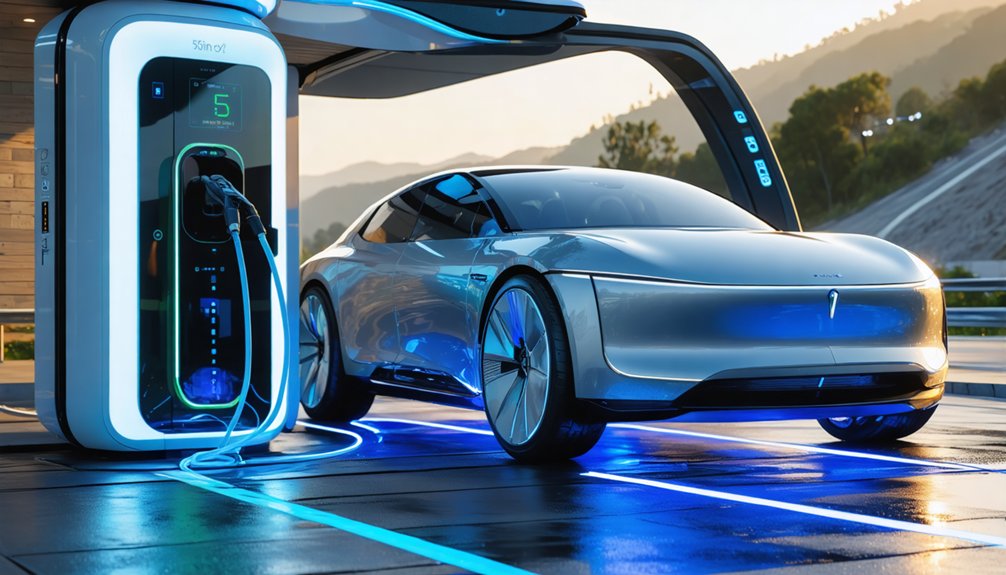

Ultra‑fast chargers delivering 150‑350 kW, and up to 1.36 MW, replenish 10‑80 % of a battery in 10‑20 minutes, shrinking typical road‑trip stops from half an hour to under five minutes. 800 V and liquid‑cooled architectures cut current and heat loss, sustaining 425‑500 A for consistent high power. Dual‑port NACS/CCS stations reduce queue times, while expanding networks now host over 10,100 350 kW+ ports nationwide. These gains enable 350‑500 mile daily ranges with only two brief pauses, and the next sections reveal deeper insights.
Highlights
- 150–350 kW stations add 100 miles in under 10 minutes, cutting charging stops to a few minutes per leg.
- Liquid‑cooled flash chargers (up to 1,360 kW) keep cell temperature optimal, allowing sustained high power and faster top‑up.
- 800 V architectures reduce current, minimizing resistive loss and enabling 425–500 A continuous charging for quicker fills.
- Dual‑connector (NACS + CCS) networks increase stall availability, lowering wait times by ~30 % and keeping trips on schedule.
- Road‑trip planners now schedule 2–3 ultra‑fast stops per day, achieving 350–500 mile daily ranges with only 20–30 minutes total charging.
How Ultra‑Fast Charging Cuts Your Road‑Trip Stops
Why do road‑trip stops shrink dramatically with ultra‑fast charging? Ultra‑fast stations providing 150–350 kW cut 100‑mile range recoveries to under 10 minutes, while megawatt‑level chargers add 500 km in five minutes. High‑utilization hubs in San Francisco and Los Angeles show 80 % usage, confirming driver confidence. Deployment accelerates: over 1,000 new DC stalls appear monthly, reaching 70,017 U.S. ports by March 2026 and projected 80,000 by year‑end. 800‑volt designs and advanced thermal management preserve Battery lifespan despite rapid energy influx, mitigating degradation risks. Grid impact is managed through liquid‑cooled flash chargers, such as BYD’s 1,360 kW units, which minimize heat loss and balance load. Consequently, road‑trip itineraries compress, cultivating a community of EV travelers who experience near‑conventional refueling convenience. Time to add 100 mi is the key metric for fast‑charging performance. The industry goal of never more than a few minutes from a power source for long trips is now within reach. APAC accounts for 56 % of global revenues, highlighting the region’s pivotal role in ultra‑fast charging expansion.
Which EVs Offer the Quickest 10‑80 % Charge Times?
Road‑trip data show that ultra‑fast charging can shrink stop times to minutes, and the decisive factor is how quickly a vehicle can accept power between 10 % and 80 % state of charge.
Among current models, the Lotus Eletre leads with a 14‑minute 10‑80 % charge, leveraging 350 kW peak power and aggressive charging voltage optimization.
The Porsche Taycan follows at 18‑22 minutes, its 800 V design sustaining 320‑325 kW while battery thermal management keeps temperatures in range.
Hyundai’s Ioniq 5 and Ioniq 6 each achieve 18‑minute cycles, supported by 800 V E‑GMP structures that balance high‑power intake with thermal control.
The Kia EV6 matches the 18‑minute benchmark, offering mainstream accessibility to ultra‑fast charging.
These figures illustrate that voltage‑optimized, thermally managed systems define the quickest 10‑80 % charge times. Battery preconditioning further reduces cold‑weather penalties, keeping average charging power high throughout the session. The 2023 Genesis GV70 Electrified adds 50 mi in 7 min to its rapid charging profile. Sustained power is a more reliable indicator of real‑world fast‑charging performance than peak kW alone.
How 800 V and Liquid‑Cooled Chargers Deliver 15‑Minute Top‑Ups
A 800 V architecture, combined with liquid‑cooled charging hardware, enables a 15‑minute top‑up by providing up to 480 kW of power while keeping battery temperature within optimal limits.
The high voltage reduces current for a given power, minimizing resistive loss and allowing Voltage optimization that sustains 425 A continuous, 500 A for short bursts.
Liquid‑cooled exchangers dissipate the 40 kW waste heat generated at extreme rates, delivering thermal management that maintains cell temperature between –40 °C and +60 °C.
Huawei FusionCharge’s 480 kW, 12‑connector CCS2 stations exemplify this integration, achieving 94 % efficiency and rapid heat removal.
The result is a reliable, community‑wide charging experience that cuts stop time to roughly fifteen minutes for a full‑range top‑up.
Cooling flow must be maintained at a minimum of 10 L/min to handle the 6 kW heat load.Reduced resistive loss improves overall system efficiency.
The Role of NACS and CCS Standard Shifts in Reducing Wait Times
Most recent data show that the concurrent adoption of NACS and CCS connectors has cut average charging‑wait times by roughly 30 % across North‑American fast‑charging networks.
The dual‑port rollout, backed by regulatory alignment, lets drivers access either standard without detouring, while standard compatibility incentives accelerate dealer and network upgrades.
NACS’s compact, five‑pin design reduces plug‑in time, and its 99 % Supercharger uptime improves session reliability.
CCS retains broad vehicle coverage and supports up to 350 kW, preserving high‑power options for non‑Tesla fleets.
Adapter solutions and retrofitted stations bridge legacy gaps, ensuring seamless transitions.
Federal NEVI funding and state mandates require both connectors, further compressing queue lengths and nurturing a unified charging ecosystem.
NACS’s future‑proof design enables power scaling up to 1 MW for heavy‑duty EVs.
Integrated communication protocol allows rapid safety handshakes, cutting connection time by seconds.~20,000 NACS DC fast chargers now provide extensive coverage, further reducing wait times.
Solid‑State Batteries: Faster Charging Meets Longer Range
Three‑to‑six‑fold reductions in charging time and up to a 100 % increase in energy density are now reported for solid‑state batteries, positioning them as a decisive upgrade over conventional lithium‑ion packs.
The solid electrolyte, a ceramic or polymer matrix, replaces liquid solvents, providing 300‑900 Wh/kg versus 150‑300 Wh/kg, and enabling 10‑80 % charge in 3‑15 minutes.
Lower internal resistance and heat generation allow current densities that charge 80 % in as little as 3 minutes without compromising solid state safety.
Lithium‑metal anodes reduce volume, extending range to 1 000 km and projected 1 200 km in second‑generation cells.
Cycle life stretches to 100 000 charges, and manufacturing scalability is advancing through Honda and Toyota pilots, promising mass‑market adoption before 2030.
Solid‑state technology also offers higher safety margins due to the elimination of flammable liquid electrolytes.High‑temperature operation improves electrolyte conductivity, enabling faster charge rates.Improved ion transport further reduces heating during rapid charging.
Real‑World Network Growth: Where You Can Find 350 kW+ Ports
The rapid charging capabilities of solid‑state batteries now intersect with a burgeoning 350 kW+ charging infrastructure that is expanding across the United States. As of early 2026, more than 10,100 connectors deliver 350 kW+ power, a 56 % year‑over‑year increase that outpaces overall DC‑fast growth (33 %). EVgo’s 200+ locations and 850 stalls across 40 states, plus Ionna’s 1,000 stalls at 100+ sites, illustrate nationwide reach. Rural coverage improves in Colorado, South Carolina, Louisiana, Mississippi, North and South Dakota, and Wyoming, narrowing the urban‑rural gap. State incentives in high‑demand markets such as Texas, Missouri, and Florida accelerate deployment, while flagship hubs—Tesla’s Los Hills Oasis and LA flagship, Electrify America’s WS Development stations—anchor the network for a growing community of ultra‑fast EV users. The network’s expansion includes new pull‑through stalls that accommodate larger vehicles.
Planning a High‑Speed EV Journey: Tips for Timing, Routes, and Amenities
A typical high‑speed EV road trip targets 350–500 miles per day, allocating 6–8 hours of driving and 2–3 fast‑charging stops while preserving a 10 % charge buffer for unforeseen delays.
Travelers should charge to 80 % before departure, then use ABRP or PlugShare to plot highways dense with DC fast chargers, ensuring redundancy and avoiding single‑charger shortcuts.
Elevation, terrain, and weather forecasts are entered into the vehicle’s guidance system to adjust range predictions.
At each stop, adhere to charger etiquette: clear occupied ports promptly, and avoid idle charging beyond the required buffer.
Align stations with rest areas, restaurants, or hotels offering 7–22 kW overnight chargers, and keep a Level‑2 cable and adapters on hand.
Monitoring real‑time availability via ChargeHub or Electrify America minimizes wait times and supports seamless, community‑focused travel.
References
- https://recharged.com/articles/fastest-charging-electric-cars-2026
- https://blinkcharging.com/blog/next-level-ev-tech-3-innovations-driving-the-future-in-2026
- https://www.greencars.com/news/the-state-of-ev-charging-in-2026-whats-improving-and-what-still-needs-work
- https://acd-inc.com/blog/key-ev-charging-trends-predictions-for-2026/
- https://chargedevs.com/newswire/evgo-adds-100-nacs-fast-charging-connectors-with-500-more-planned-in-2026/
- https://egbatt.com/2026-ev-charging-technology-trends-megawatt-systems-v2g-vpp-and-the-future-of-commercial-electrification/
- https://www.youtube.com/watch?v=J6O2Y0xkyTk
- https://www.ezevelectric.com/ev-charging-industry-predictions-and-trends-2026/
- https://www.recurrentauto.com/research/fastest-charging-evs
- https://www.fortunebusinessinsights.com/ultra-fast-ev-charging-systems-market-115807