
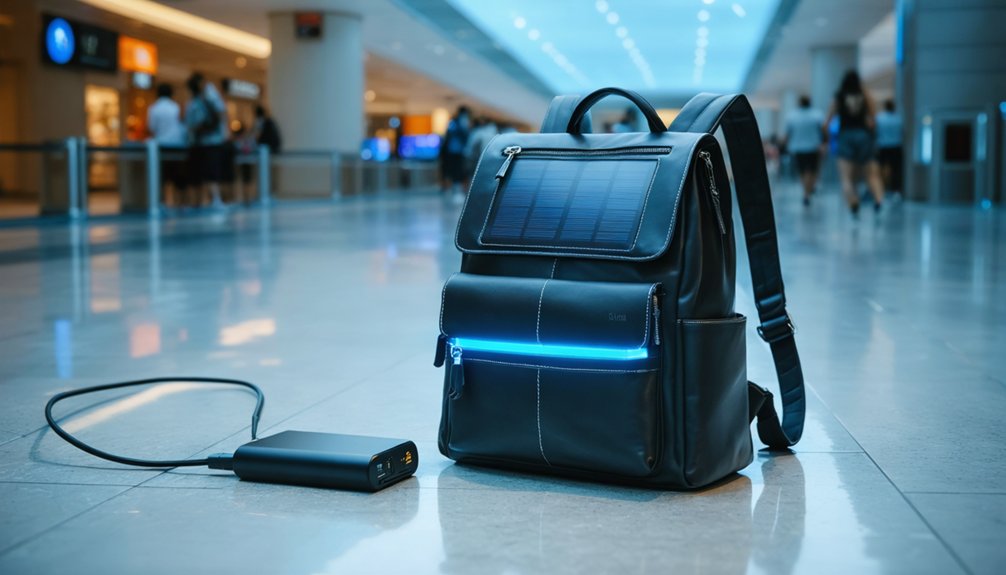

Smart travel gear consolidates power, security, and organization into compact, regulated solutions. Integrated USB‑C chargers and high‑capacity banks deliver up to 140 W, eliminating public stations. Digital locks, biometric scanners, and remote GPS tracking protect luggage and enable instant location alerts. Self‑weighing compartments enforce airline weight limits while RFID‑blocking layers safeguard personal data. Modular cubes, expandable sections, and compression bags maximize packing efficiency. eSIM‑ready phones and portable 5G hotspots guarantee seamless global connectivity. Continued exploration reveals deeper benefits and selection tips.
Highlights
- Integrated high‑capacity USB‑C PD chargers eliminate the need for public stations, powering laptops and phones simultaneously.
- Smart locks with biometric and Bluetooth access prevent forgotten keys and enable remote locking for luggage security.
- Built‑in GPS tracking and alerts locate misplaced bags instantly, reducing loss and mishandling incidents.
- Self‑weighing scales and RFID shields ensure compliance with airline weight limits and protect personal data.
- eSIM‑ready devices and portable 5G hotspots provide instant global connectivity, keeping travelers online without roaming fees.
How Built‑in USB Chargers Keep Your Devices Powered on the Go
Although public USB ports promise convenience, built‑in USB chargers in luggage, backpacks, and travel accessories deliver power without exposing devices to data‑theft risks.
Integrated fast‑in power modules draw from dedicated battery packs, often the size of a soda can, and feed travel‑ready ports that support USB‑C Power Delivery up to 140 W. This arrangement eliminates the need for public stations, where FBI and TSA warnings highlight juice‑jacking threats.
Users can charge a MacBook Air once or an iPhone fourteen times before recharging, thanks to high‑capacity cells such as the 27,650 mAh Anker Prime. By standardizing on USB‑C, manufacturers provide a single connector for phones, tablets, and laptops, nurturing a sense of community among travelers who share reliable, secure power on the road. Using a USB data blocker can further protect devices from hidden data‑extraction threats while charging. Including a charge‑only cable ensures that even if a port is compromised, no data can be transferred. The dedicated charging port supplies power without enumeration, reducing the risk of data exposure.
Why Digital Locks and Biometric Scanners Are the New Travel Security Standard
Built‑in USB chargers have already demonstrated how integrated power can protect travelers from public‑station threats, and the next logical evolution in luggage safety is the adoption of digital locks and biometric scanners.
Market data shows electronic suitcase lock sales projected to rise $204 million by 2032, with smart lock valuations hitting $8.4 billion by 2036, underscoring rapid acceptance.
Biometric convenience—fingerprint, facial, palm‑vein scans—replaces forgotten keys, providing encrypted credentials and audit trails that reinforce digital resilience.
Bluetooth‑enabled devices command 52 % of the 2026 share, offering power‑efficient proximity unlocking.
RFID technology supports rapid, contactless entry for frequent travelers and logistics operators.
North America, Europe, and the fast‑growing Asia‑Pacific region drive adoption, while insurers and enterprises reward sturdy, tamper‑detecting solutions.
Despite cybersecurity concerns, the blend of seamless connectivity and personalized security is redefining travel standards.
Global market is projected to reach $284 M by 2025. smart‑city adoption] fueling demand for integrated travel security solutions.
Tracking Your Luggage in Real Time: GPS Features and Remote Locking Explained
Amid the surge of smart‑luggage adoption, GPS tracking now serves as the backbone of real‑time luggage monitoring, triangulating satellite signals to pinpoint a bag’s location and streaming the data instantly to a companion smartphone app.
The system delivers GPS alerts whenever the bag moves unexpectedly, allowing travelers to intervene during layovers, boarding, or claim.
Integrated Bluetooth layers local proximity checks, while remote locking users to secure compartments from afar, preventing unauthorized access even if the suitcase is misplaced.
Market data shows a 11.8 % CAGR for GPS connectivity, reflecting growing confidence among frequent flyers. Over 25 million luggage mishandlings occur each year. The Asia‑Pacific region is the fastest‑growing market for smart travel gear. Europe holds the largest share of global revenue.
Self‑Weighing and RFID Protection: Staying Within Limits and Safeguarding Data
How does a suitcase that weighs itself and shields its data change the travel experience? A self‑weighing case embeds a scale in its frame, letting travelers confirm weight limits before heading to the airport.
By eliminating separate devices, it reduces the logistical friction of pre‑flight checks, while the added weight of the mechanism marginally trims packing capacity.
Portability & Convenience is enhanced by the compact, lightweight design that fits easily in carry‑on or suitcase.Scale accuracy can be verified at home, preventing unnecessary overweight fees caused by poorly calibrated airport scales.
Simultaneously, integrated RFID security blocks unauthorized scanning of passports, credit cards, and boarding passes stored in hidden pockets, preserving personal data.
Frequent flyers and families benefit from avoiding costly overweight fees, often exceeding the modest $10‑$30 investment in the technology.
The combined features promote confidence, encouraging a sense of belonging among travelers who value convenience, safety, and data protection.
Compact digital scales provide precise measurements up to 50 kg, ensuring travelers stay within airline limits.
Packing Smart: Expandable Compartments, Cubes, and Compression Bags for Maximum Space
Maximizing luggage capacity hinges on strategic compartmentalization, where expandable sections, modular cubes, and compression bags convert a chaotic assortment of items into a Tetris‑like arrangement that exploits every cubic inch.
Studies show that modable compartments improve efficiency by allowing travelers to segment clothing, toiletries, and electronics, reducing rummage time and stress.
Small cubes hold socks and underwear, while larger units accommodate sweaters, creating a visual inventory that feels like a shared, organized space.
Compression bags further shrink bulkier garments, enabling carry‑on compliance and freeing room for souvenirs.
Multi‑functional design extends beyond trips; cubes double as home organizers and pre‑packed kits, providing long‑term value and a sense of belonging to a community of savvy travelers.
Water‑resistant cubes protect contents from light moisture while maintaining breathability.
The market is projected to reach USD 26,540.80 million by 2032, reflecting strong demand for innovative packing solutions.
Using durable, lightweight nylon reduces wear over hundreds of trips, ensuring the cubes remain functional and reliable.
Choosing the Right Power Bank and Universal Adapter for Seamless Charging
The organized compartments that streamline packing also set the stage for efficient power management on the road, where a traveler’s choice of power bank and universal adapter determines whether devices stay charged without compromising airline regulations.
Selecting a unit with 10,000 mAh (≈ 7 Wh) balances daily smartphone use and carry‑on limits, while a 20,000 mAh (≈ 99 Wh) model maximizes weekend flexibility for tablets and light laptops.
For frequent flyers, the 27,000 mAh range pushes the FAA ceiling, enabling full ultrabook charges.
Critical is Adapting voltage: efficient banks convert 3.7 V cells to 5 V USB output with 80‑90 % efficiency, so Wh ratings guide real‑world performance.
Pairing a universal adapter that supports PD up to 140 W guarantees Optimizing capacity across multiple ports, preserving community confidence in seamless travel power.
Staying Connected Abroad: eSIM‑Ready Phones, Global Wi‑Fi Hotspots, and 5G Travel Routers
Across continents, travelers increasingly rely on eSIM‑ready phones, global Wi‑Fi hotspots, and 5G travel routers to maintain seamless connectivity.
eSIM technology eliminates the need for physical cards, allowing instant activation of local data plans through services such as Google Fi, Truphone, or Holafly’s $64.90‑per‑month unlimited offering in 170+ destinations.
The flexibility of eSIM pricing lets users match budget to itinerary, while hotspot battery life—often six hours on devices like Huawei E5576‑320—determines how long groups stay online without recharging.
Pocket‑sized 5G routers, such as Numen Air, deliver 574 Mbps on 2.4 GHz and 242 Mbps on 5 GHz, supporting multiple devices and stabilizing hotel Wi‑Fi.
Together, these tools create a reliable network fabric that nurtures community, reduces stress, and reinforces the sense of belonging for modern globetrotters.
References
- https://www.grandviewresearch.com/industry-analysis/smart-luggage-market-report
- https://thegadgetflow.com/blog/ces-2026-travel-tech/
- https://www.theinnatstonecliffe.com/blog/the-ultimate-packing-list-best-items-for-travel-in-2026-including-mackinac-island-essentials
- https://www.youtube.com/watch?v=AhbumQ1XZ4o
- https://www.smartertravel.com/the-real-rules-for-carry-on-luggage/
- https://www.cu.edu/security/stay-cybersecure-while-traveling-avoid-public-usb-charging-risks
- https://www.anker.com/blogs/power-banks/what-is-juice-jacking
- https://www.electricalsafetyfirst.org.uk/guidance/product-safety/usb-chargers/
- https://www.canada.ca/en/health-canada/services/consumer-product-safety/legislation-guidelines/guidelines-policies/information-regulated-parties-enforcement-approach-general-prohibitions/danger-human-health-safety-assessment-usb-chargers.html
- https://en.wikipedia.org/wiki/Juice_jacking