
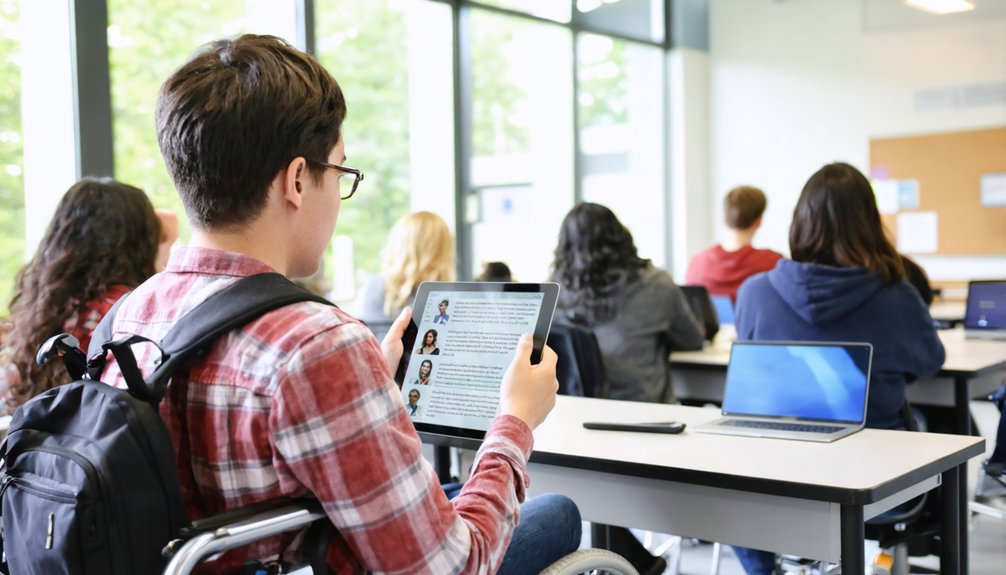

Hybrid learning removes physical obstacles by allowing wheelchair users and visually impaired students to join via virtual interfaces that comply with Section 508 and ADA standards. Asynchronous sessions provide flexible pacing and multimodal content, supporting learners with ADHD, dyslexia, and cognitive challenges. Adaptive media, WCAG‑compliant alt‑text, and automatic captions improve comprehension for 98.6 % of students. Single sign‑on and multi‑device access reduce login fatigue and guarantee consistent participation across tablets, phones, and laptops. These features collectively enhance retention, grades, and equity for under‑represented groups, and further details illustrate how data‑driven analytics personalize support.
Highlights
- Hybrid formats let students with mobility impairments attend via video, bypassing stairs, railings, and distant campus facilities.
- Screen‑reader‑compatible digital content and alt‑text standards enable visually impaired learners to access lectures and materials.
- Closed captions and automated transcription provide auditory support for deaf, hard‑of‑hearing, and cognitive‑impairment students.
- Single sign‑on and multi‑device access reduce login barriers, allowing seamless participation from tablets, phones, or laptops.
- Asynchronous recordings and flexible pacing let learners with ADHD, dyslexia, or executive‑function challenges review material on their own schedule.
How Hybrid Learning Breaks Down Physical Barriers
By eliminating the need for physical presence, hybrid learning dismantles traditional campus obstacles; data show that 71.6 % of college students with disabilities enroll in online or hybrid programs, thereby bypassing stairs, distant facilities, and inaccessible transportation.
Hybrid models replace physical movement with virtual interfaces, allowing wheelchair users to attend lectures without confronting stairs, railings, or uneven terrain.
Visually impaired learners benefit from screen‑reader‑compatible digital content, reducing the energy spent traversing large, poorly marked spaces.
Legal compliance under Section 508 and the ADA drives institutions to design barrier‑free hybrid platforms, ensuring web content and learning tools meet accessibility standards.
Consequently, 55 % of disabled students now engage in hybrid or fully online courses, experiencing greater control, reduced fatigue, and a sense of inclusion across academic and extracurricular activities.
Research on inclusive primary schools in Indonesia shows that clear instructions are essential for hybrid learning success for students with learning disabilities. The pandemic accelerated online adoption highlighting the need for rapid accessibility upgrades.
Why Asynchronous Sessions Boost Accessibility for Diverse Learners
Hybrid learning’s removal of physical constraints sets the stage for a deeper examination of temporal flexibility, as asynchronous sessions directly address the varied needs of diverse learners.
Data show that 71.6 % of college respondents have taken online courses, and outcomes are statistically equivalent to synchronous instruction (pretest p = 0.7785, posttest p = 0.5559, retention p = 0.4435).
Flexible pacing enables students with learning disabilities, ADHD, and other cognitive challenges to review recordings, use digital pen‑technology, and align study with personal schedules, reducing reliance on ad‑hoc accommodations.
Instructor presence can mitigate executive‑function challenges, supporting deeper conceptual understanding for students with disabilities.
By embedding universal design principles, asynchronous content offers multimodal access, supports achievement, and cultivates a sense of belonging across geographic and socioeconomic boundaries.
This temporal adaptability underpins broader accessibility within hybrid models.
Adaptive Media and Clear Instructions: Tools That Support Students With Disabilities
How do adaptive media and clear instructions convert learning experiences for students with disabilities? Data show adaptive media raises achievement for elementary learners with learning disabilities, yet only 39‑56 % of schools deploy such software. WCAG 2.1 Level AA updates (2023) mandate Alt text standards and Caption automation for visual, auditory, and cognitive impairments. Audits reveal that merely 3 % of the web is accessible, underscoring the need for systematic alt‑text integration. Closed captions benefit 98.6 % of students, with 87 % of institutions adding them reactively. Text‑to‑speech and screen readers support 15‑20 % of global dyslexic learners, though fewer than 7 % report adequate support. Keyboard alternatives reach 55‑64 % of schools, narrowing the gap for fine‑motor challenges. These tools collectively encourage inclusive, belonging‑centered hybrid learning environments. Districts ≥ 50,000 must meet compliance by April 2026. 12.1 % of the population experiences mobility difficulties, highlighting the importance of accessible design.
The Role of Single Sign‑On and Multi‑Device Access in Inclusive Education
Adaptive media and clear instructions have already demonstrated measurable gains for students with disabilities, yet their impact is limited without seamless entry to the digital resources that host them.
Single sign‑on (SSO) eliminates repeated log‑ins, allowing instant access to virtual classrooms across tablets, phones, and laptops.
By issuing secure tokens, SSO reduces password fatigue and cuts forgotten‑password incidents, saving instructional time for educators.
Federated identity enables credential sharing among diverse student information systems, preserving privacy compliance such as COPPA and FERPA while supporting multi‑factor authentication for younger users.
Data show 53 % of students spend three or more hours daily on edtech; SSO’s streamlined workflow lowers abandonment rates by up to 18.75 %.
Consistent multi‑device access cultivates belonging, ensuring all learners can participate fully in hybrid environments. Security enhancements are achieved through integrated MFA, which strengthens defense against cyber‑attacks. One‑third of faculty are not at all aware of WCAG requirements. Centralized access control reduces unauthorized entry across campus platforms.
How Hybrid Models Improve Retention and Grades for Under‑Represented Groups
Three‑quarters of under‑represented students report that hybrid learning environments enhance both engagement and academic outcomes, a trend supported by quantitative analyses.
Path analysis shows a 0.582 coefficient (p < 0.001) linking hybrid flexibility to increased participation, while digital tools add a 0.192 effect (p = 0.018).
These engagement gains correspond to a 0.550 performance coefficient (p < 0.001) and Cohen’s d ≥ 0.8 pre‑to‑post test gains for Hispanic and Black cohorts.
Retention incentives manifest in 25‑60 % higher persistence when online components are included, and attrition among students of color declines sharply.
Equity metrics reveal that hybrid formats narrow achievement gaps, with 82 % of under‑represented learners preferring this model over traditional settings, reinforcing both belonging and academic success.
The global preference for hybrid learning is strongest in North America and Africa, driving higher application shares for hybrid programs in 2023.
The study also highlights the critical role of digital tools in supporting learner agency and interaction.
Teacher Resources and Training That Make Hybrid Teaching Accessible
The documented gains in engagement and performance among under‑represented students highlight the need for strong teacher preparation, and professional‑development programs now focus on equipping educators with the skills and tools required for accessible hybrid instruction.
Data show that curricula incorporate faculty hybrid curriculum modules, while faculty mentorship structures reduce workload and improve coordination across synchronous and asynchronous streams.
Training covers reliable internet, device compatibility, low‑bandwidth and offline solutions, and adaptive learning features that support rural, gifted, and students with reading difficulties.
Workshops teach intentional design of HyFlex spaces, microlearning, and unified experiences that prevent parallel courses.
Institutional support aligns policies, analytics skills, and BYOD policies, ensuring teachers can deliver rigorous, inclusive lessons without sacrificing rigor.
Hybrid models have been shown to produce student outcomes that often exceed peers in comparable brick‑and‑mortar settings.Unified platform further streamlines resource sharing across classrooms.
The 94 % of students taking hybrid courses have enrolled in 1‑6 hybrid classes since admission.
Real‑Time Data Monitoring: Personalizing Support for Every Learner
Across hybrid classrooms, real‑time data monitoring enables institutions to tailor support for each learner by integrating attendance, performance, and engagement metrics into unified dashboards.
Dedicated platforms such as AccuClass capture in‑person and remote attendance via QR codes and mobile apps, syncing instantly to cloud dashboards that flag absentee patterns.
Simultaneously, performance dashboards aggregate weekly observation data, baseline assessments, and VLE interaction logs, providing granular perception into academic progress and behavioral engagement.
Equity analytics surface disparities across demographic groups, guiding targeted interventions while strict Data privacy protocols anonymize personal identifiers.
Administrators receive automated alerts that trigger timely outreach, and instructors adjust instruction in real time based on sub‑task analysis, ensuring every learner experiences inclusive, responsive support.
20 % of parents would enroll child in hybrid school if option available.
References
- https://www.livewebinar.com/blog/education/2021-hybrid-learning-statistics-in-a-nutshell
- https://www.kneoworld.com/accessibility-of-hybrid-learning-models/
- https://nsuworks.nova.edu/cgi/viewcontent.cgi?article=5432&context=tqr
- https://pmc.ncbi.nlm.nih.gov/articles/PMC11241882/
- https://campustechnology.com/articles/2021/09/09/survey-accessibility-challenges-persist-as-hybrid-and-online-learning-continues.aspx
- https://er.educause.edu/articles/2023/2/hybrid-learning-and-space-reimagination-optimizing-access-and-equity-to-promote-student-success
- https://cjlt.ca/index.php/cjlt/article/view/28349/20713
- https://dl.acm.org/doi/full/10.1145/3711670.3764652
- https://oidigitalinstitute.com/news/how-hybrid-and-online-learning-supports-student-accessibility-and-affordability/
- https://pmc.ncbi.nlm.nih.gov/articles/PMC11936882/